Written by Hafsa Ejaz | Medically reviewed by Dr Ejaz Ahmad
A retirement home suits a parent who can still manage most daily tasks and mainly wants safety, company, meals and help on hand. A nursing home suits a parent who needs hands-on help every day, such as bathing, eating, moving or taking medicines, plus regular nursing supervision.
That is the short answer to retirement home vs nursing home. The right choice depends on what your parent can do safely today, and what they are likely to need next year. This guide explains both options in plain words, how Malaysian law treats them, and five questions that help you decide. If you already know your parent is fairly independent, see retirement living at Noble Care. If they need daily care, start with Noble Care nursing homes in 16 locations.
Retirement home vs nursing home at a glance
The biggest difference is the level of care. Everything else, from the room to the daily routine, follows from that.
| Factor | Retirement home | Nursing home |
|---|---|---|
| Who it suits | Older adults who are mostly independent | Older adults who need help with daily tasks or ongoing nursing care |
| Daily personal care | Light help when asked | Hands-on help with bathing, dressing, eating, toileting and moving |
| Nursing and medicines | Reminders or support with medicines; some homes have nurses on site | Medicines given and recorded; regular nursing supervision |
| Health conditions | Stable health, few changes week to week | Conditions that need watching, such as dementia, stroke recovery or tube feeding |
| Daily life | Own routine, activities, outings and social time | Structured routine built around care, with activities adapted to ability |
| How Malaysian law treats it | Not a term used in Act 506 or Act 586; a home caring for 4 or more residents is a care centre under Act 506 | A private nursing home providing nursing care is licensed under Act 586 |
| Best first step | Visit and see if the lifestyle fits | Get a care assessment, then visit |
What a retirement home offers, and who it suits
A retirement home is a place to live, first. Residents have their own or a shared room, meals are cooked for them, and cleaning and laundry are taken care of. Staff are around if something goes wrong, but residents still plan their own day.
Daily life in a retirement home
A typical resident walks without much help, can wash and dress themselves, and handles most of their own routine. What they want is less worry: no cooking for one, no house repairs, and people to talk to. Many families choose a retirement home because a parent has become lonely at home, not because they are unwell.
A retirement home is usually not enough when a parent needs help every day with personal care, has frequent falls, or has memory loss that makes it unsafe to be left alone.
Retirement living at Noble Care
Noble Care’s retirement living sits at the more supported end. As described on our retirement home page, it includes:
- 24/7 security and medical assistance
- Fully furnished, air-conditioned private or shared rooms
- Meal plans designed for seniors, plus housekeeping and laundry
- Events, games and group exercise
- Professional nurses and caregivers available, help with daily tasks and movement, and regular monitoring with timely medication
- Physiotherapy, counselling and wellness programmes
Ask our team which location suits your parent.
What a nursing home offers, and who it suits
A nursing home is built around care. Staff help residents with the basics of daily life, and nurses watch over health conditions and medicines. Under Malaysian law, “nursing care” means care given by a registered nurse, following the directions of a registered doctor (Act 586, section 2).
Hands-on daily care and nursing supervision
Families usually look at a nursing home when a parent:
- Needs help to bathe, dress, eat or use the toilet
- Needs medicines given and recorded, not just reminders
- Has had a stroke or surgery and needs help to move safely
- Is living with dementia and may wander or forget to eat
- Is bed-bound, or needs nursing procedures such as tube feeding, catheter care or wound dressing
If several of these sound familiar, a retirement home will probably not give your parent enough support.
Noble Care nursing homes in 16 locations
Noble Care runs nursing homes across Malaysia. Our 16 centres are in Ampang, Cheras, Ipoh, Jalan Ipoh (KL), Johor Bahru, Kajang, Klang, Mid Valley, Penang, Petaling Jaya, Rawang, Semenyih, Seremban, Serendah, USJ 9 and USJ 18 (Subang Jaya). Our services include dementia care, stroke care, palliative care and respite stays, as well as specialised nursing services such as NG tube changing, Foley’s catheter care, bedsore dressing and tracheostomy care.
How Malaysia regulates care homes
In Malaysia, the law groups homes by the care they give, not by the name on the sign. Two laws matter most:
- Care Centres Act 1993 (Act 506). Any premises at which 4 or more people are received for care as residents is a “residential care centre” (Act 506, section 2). These centres must register with the Social Welfare Department, JKM (JKM registration guide). Homes for older people are registered as care centres for the elderly (pusat jagaan warga emas).
- Private Healthcare Facilities and Services Act 1998 (Act 586). A “private nursing home” is premises that receive and provide nursing care for people who are sick, injured, infirm or recovering, and it needs a licence to operate (Act 586, sections 2 and 3).
The Private Aged Healthcare Facilities and Services Act 2018 (Act 802) was gazetted in 2018 but is not yet in force.
Neither Act uses the term “retirement home”. So when you visit any home, ask which JKM registration or Ministry of Health licence it holds, and whether that matches the care your parent needs. Noble Care is registered with JKM, as stated on our About page. For a full visit checklist, read our guide to choosing a nursing home in Malaysia.
Old folks home, assisted living, retirement village: what the names mean
Malaysian families use these names loosely, and one centre may use several of them. Here is how they are usually meant. For the old age home question in more detail, see how an old age home differs from a nursing home.
Old folks home or old age home
The everyday name for a home where older people live and receive care. It can mean anything from light support to full daily care, so always ask what care is actually provided.
Assisted living
A term borrowed from overseas for homes where residents live fairly independently but get help with some daily tasks. In Malaysia, it usually sits between a retirement home and a nursing home.
Retirement village
Usually a housing development for older adults who live on their own, often in their own unit, with shared facilities. Care is limited or arranged separately.
Which fits your parent? 5 questions to decide
Answer these honestly, ideally together with your parent and their doctor.
- Can they bathe, dress, eat and use the toilet without help?
- Do they need medicines given or supervised, or any nursing procedure?
- Have they had falls, or do they need help to walk or move from bed to chair?
- Is memory loss making it unsafe for them to be alone, or are they wandering?
- Do they have a health condition that needs regular checks by a nurse?
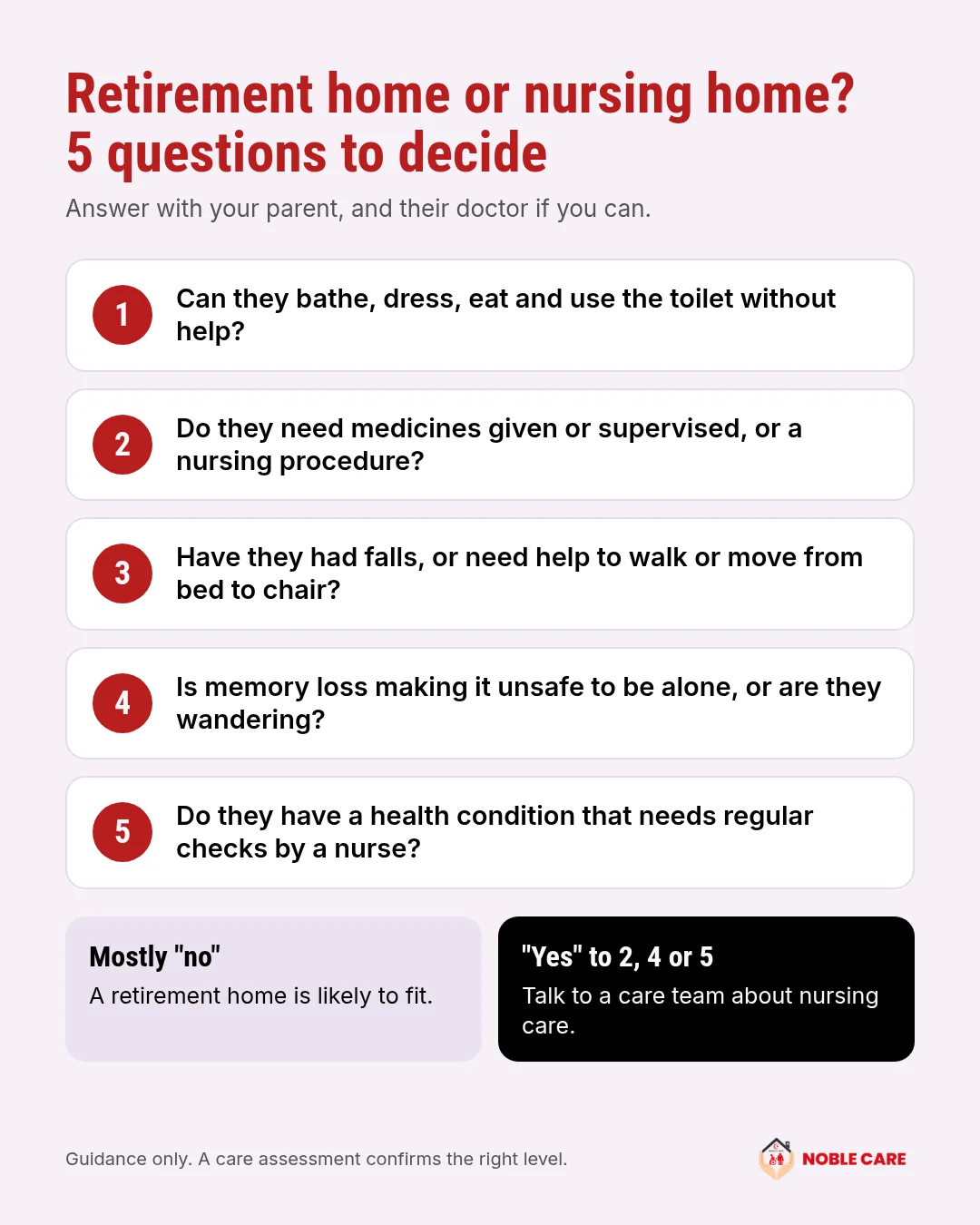
If the answers are mostly “no”, a retirement home is likely to be a good fit. If you answered a clear “yes” to question 2, 4 or 5, talk to a care team about nursing care. If you are unsure, a care assessment can help. At a free consultation, our team looks at your parent’s health, mobility and daily routine and explains which options may suit them.
When needs change: moving from retirement living to nursing care
Needs rarely stay the same. A parent who moves into a retirement home at 70 may need more help a few years later, after a fall, a hospital stay or a dementia diagnosis.
Signs it may be time to review the care level include more falls, weight loss, missed medicines, new confusion, or needing help with personal care most days. When that happens, ask for a reassessment rather than waiting for a crisis. At Noble Care, care plans are reviewed as needs change, and short-term respite care can give a family time to adjust while longer-term care is arranged.
Visiting and next steps
The best way to decide is to see a centre in person. Bring a short list of your parent’s needs, meet the team, and look at the rooms and daily routine. You can book a visit or a free consultation, with no obligation to proceed. Whether you are weighing a nursing home vs retirement home for Mum or Dad, the team can talk it through with you. Family members in Singapore or China can join the consultation online. You can also call us on +60-167786795 or message us on WhatsApp.
Frequently asked questions
What is the difference between a retirement home and a nursing home?
A retirement home is for older adults who are mostly independent and want safety, company and services such as meals and housekeeping. A nursing home is for people who need hands-on help every day and regular nursing care. The deciding factor is how much daily care your parent needs.
What is the difference between an old age home and a retirement home?
In Malaysia, “old age home” or “old folks home” is an everyday name for a home where older people live and receive care, and the care level varies a lot between homes. “Retirement home” usually means a more independent, lifestyle-focused option. Ask any home what care it actually provides.
What is another name for a retirement home?
Common names include retirement residence, retirement village, senior living and independent living. In Malaysia, people may also say old folks home, and JKM registers homes for older people as care centres for the elderly (pusat jagaan warga emas).
Is there a difference between a care home and a nursing home?
Yes. Under Malaysian law, a home caring for 4 or more residents is a care centre registered with JKM under the Care Centres Act 1993. A private nursing home provides nursing care and is licensed under the Private Healthcare Facilities and Services Act 1998. Many centres use the word “nursing home” loosely, so ask which registration or licence a home holds.
What age is best for a retirement home?
There is no single right age. The better question is what your parent can manage safely. Moving while they are still independent lets them settle in and enjoy the social side. Waiting until a crisis often means the choice is rushed.
About this article. Written by Hafsa Ejaz. Medically reviewed by Dr Ejaz Ahmad, CEO, Noble Care. [REVIEWER BIO PENDING]